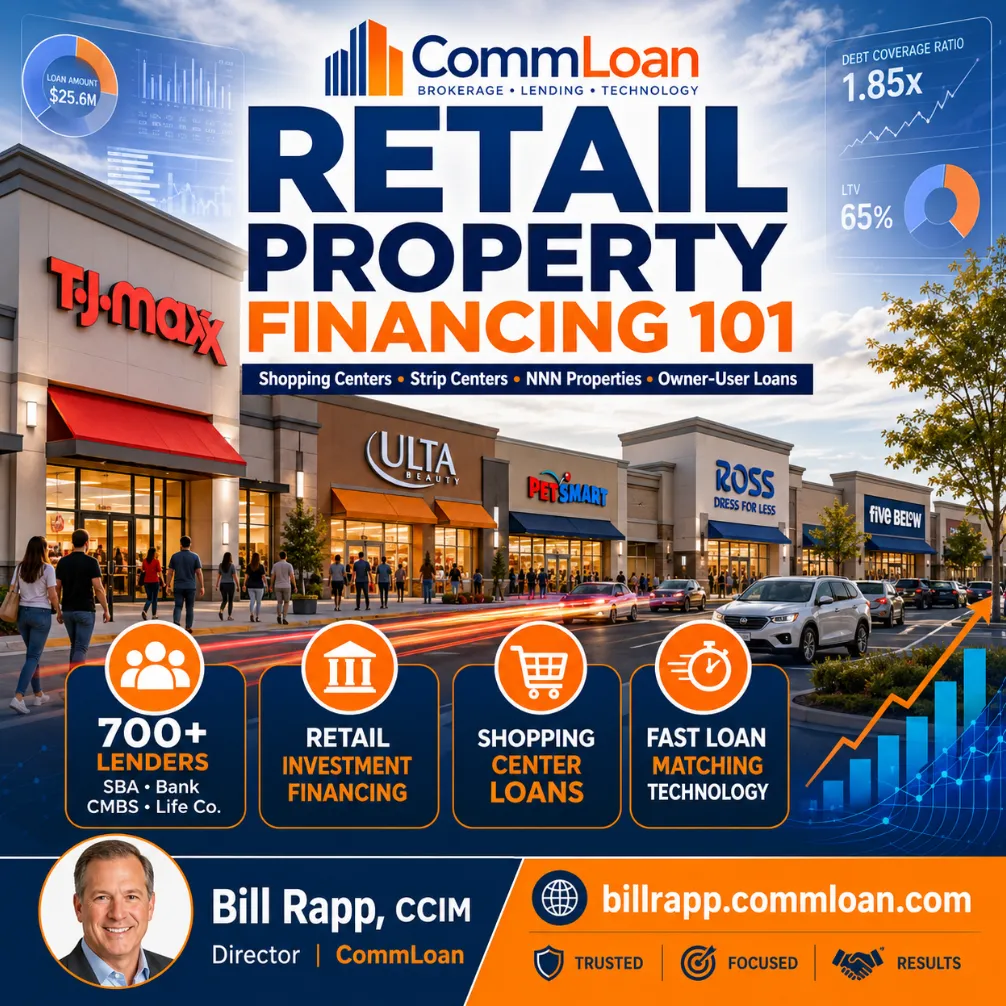
🏬 Retail Property Financing 101: How to Secure the Best Loan for Shopping Centers and Retail Investments 💰
🏬 Retail Property Financing 101: How to Secure the Best Loan for Shopping Centers and Retail Investments 💰
🚀 Retail Property Loans Explained: Financing Strategies for Investors and Owner-Users 🏪
Retail Property Financing 101
Retail real estate remains one of the most popular commercial property sectors for investors and business owners. From neighborhood strip centers and standalone retail buildings to multi-tenant shopping centers and mixed-use developments, retail properties can generate strong cash flow and long-term wealth when financed properly.
Understanding how retail property financing works can help investors secure better loan terms, improve returns, and avoid costly mistakes.
What Is Retail Property Financing?
Retail property financing refers to loans used to purchase, refinance, renovate, or develop retail real estate.
Common retail property types include:
·Shopping Centers
·Strip Centers
·Neighborhood Retail Centers
·Standalone Retail Buildings
·Restaurant Properties
·Drugstores
·Convenience Stores
·Triple-Net (NNN) Retail Properties
·Mixed-Use Retail Developments
Lenders evaluate retail properties differently than residential properties because they focus heavily on cash flow, tenant quality, occupancy, and property performance.
What Lenders Look For
When financing retail properties, lenders typically evaluate:
Occupancy
Higher occupancy generally reduces lender risk.
Preferred occupancy often exceeds 80% to 90%.
Tenant Quality
National and regional tenants often receive favorable treatment because they provide stable income streams.
Examples include:
·Starbucks
·Walgreens
·Dollar General
·Chick-fil-A
·Walmart Neighborhood Market
Net Operating Income (NOI)
NOI is one of the most important underwriting metrics.
Lenders want to see that the property's income comfortably covers debt payments.
Debt Service Coverage Ratio (DSCR)
Most lenders prefer a DSCR between 1.20x and 1.35x.
A higher DSCR demonstrates stronger ability to service debt.
Property Location
Strong demographics, traffic counts, visibility, and population growth can improve financing options.
Common Retail Loan Options
Bank Loans
Best for:
·Owner-users
·Local investors
·Stabilized properties
Typical Features:
·Competitive rates
·20–30 year amortization
·5–10 year fixed periods
·Recourse often required
Credit Union Financing
Credit unions often offer flexible underwriting and attractive terms for local business owners.
Best for:
·Smaller retail properties
·Owner-occupied buildings
·Relationship borrowers
SBA Loans
For owner-occupied retail properties, SBA financing can be one of the most powerful tools available.
Programs include:
SBA 7(a)
·Acquisition
·Working capital
·Equipment
·Business expansion
SBA 504
·Lower down payments
·Long-term fixed financing
·Real estate acquisition
CMBS Loans
Commercial Mortgage-Backed Securities (CMBS) financing works well for larger stabilized retail assets.
Benefits:
·Non-recourse options
·Competitive rates
·Longer terms
Considerations:
·More complex servicing
·Prepayment penalties
Life Company Loans
Life insurance companies often target:
·High-quality retail centers
·Strong sponsorship
·Long-term investment properties
Benefits include:
·Competitive rates
·Longer fixed-rate periods
·Flexible structures
Debt Funds and Bridge Loans
Bridge financing helps investors:
·Acquire underperforming properties
·Fund renovations
·Improve occupancy
·Execute value-add strategies
These loans generally close faster than conventional financing.
How Much Down Payment Is Required?
Typical retail property down payments range from:
·10%–15% for certain SBA programs
·20%–30% for conventional financing
·25%–40% for value-add opportunities
·Higher equity requirements for construction projects
The stronger the property and borrower profile, the more aggressive lenders may become.
Documents You'll Need
Most retail lenders request:
·Rent Roll
·Current Leases
·T-12 Operating Statement
·Personal Financial Statement
·Real Estate Schedule
·Tax Returns
·Organizational Documents
·Property Photos
·Purchase Contract (if applicable)
Preparing documentation early can significantly speed up loan approvals.
Retail Financing Challenges
Common issues that impact loan approval include:
·High vacancy
·Short-term leases
·Tenant concentration
·Deferred maintenance
·Weak market conditions
·Declining tenant sales
Understanding these concerns allows borrowers to address potential lender objections proactively.
How Technology Is Changing Retail Financing
Historically, commercial borrowers had limited visibility into lender options.
Today, technology-driven marketplaces allow borrowers to access hundreds of lenders and thousands of loan programs more efficiently. CommLoan's CUPID™ technology helps match borrowers with lenders based on property type, borrower profile, and financing objectives while accessing a network of more than 700 lenders nationwide.
This creates more transparency, additional financing options, and faster lender matching.
Final Thoughts
Retail property financing is about much more than securing the lowest interest rate.
The right loan structure can improve cash flow, reduce risk, increase flexibility, and enhance long-term returns.
Whether you're purchasing a strip center, refinancing a shopping center, acquiring a net-leased property, or expanding your business into an owner-occupied retail location, understanding available financing options is critical to investment success.
Working with an experienced commercial mortgage advisor can help you compare lenders, evaluate structures, and identify financing solutions aligned with your investment strategy.
Bill Rapp, CCIM
Director | CommLoan
📞 281-222-0433
📧 [email protected]
🌐 https://billrapp.commloan.com/
Commercial Real Estate Financing Nationwide
https://billrapp.commloan.com/
https://author.billrapponline.com/
https://www.amazon.com/dp/B0F32Z5BH2
https://veed.cello.so/FOmzTty6oi9
https://buymeacoffee.com/vikingente3
https://creplaybookseries.billrapponline.com
https://creplaybook.billrapponline.com/
©Bill Rapp, CCIM - Director - Commloan