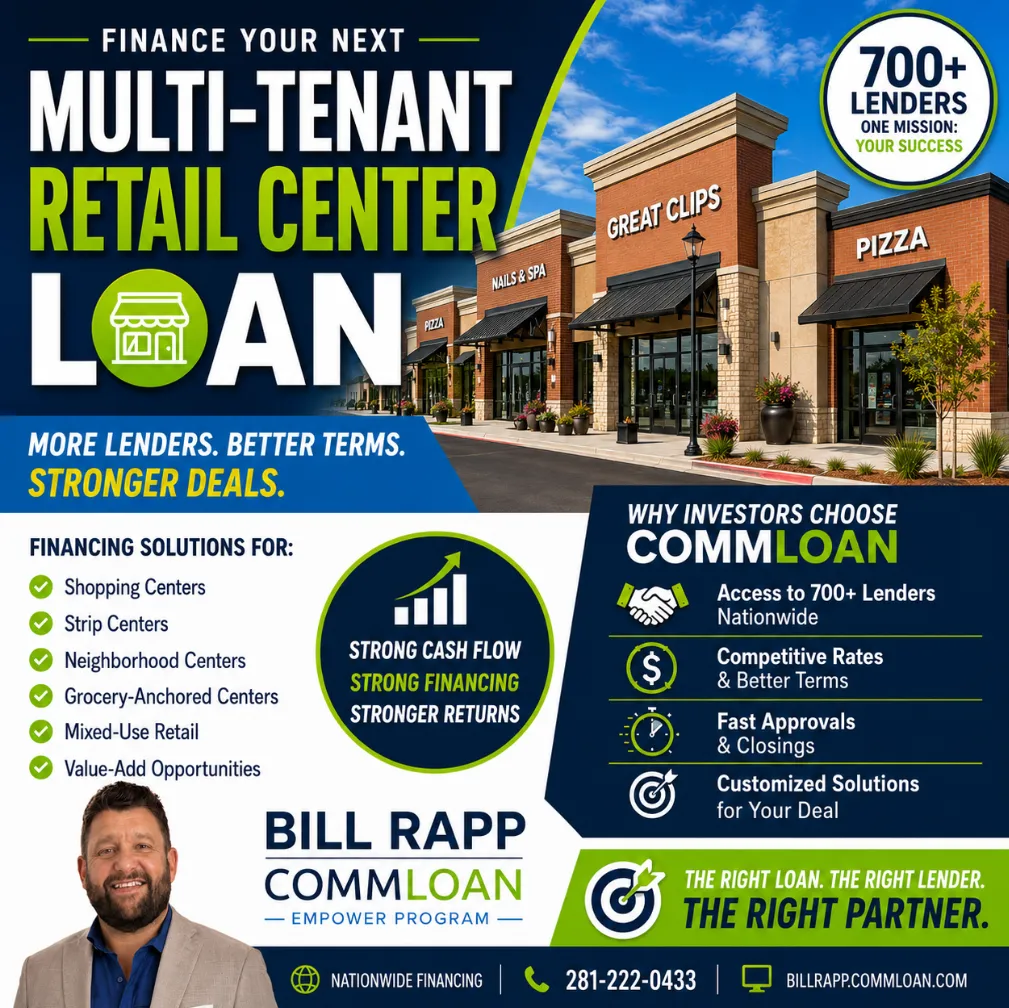
🏬 Multi-Tenant Retail Center Loans: The Complete Financing Guide for Investors 💰
🏬 Multi-Tenant Retail Center Loans: The Complete Financing Guide for Investors 💰
🏢 Secure the Best Multi-Tenant Retail Center Loan: Everything Investors Need to Know 📈
Multi-Tenant Retail Center Loans: The Complete Financing Guide
Multi-tenant retail centers remain one of the most attractive commercial real estate investments available today. From neighborhood shopping centers and strip centers to grocery-anchored developments, retail properties continue generating strong cash flow when properly leased and managed.
The challenge isn't finding financing—it's finding the right financing.
With access to over 700 commercial lenders through the CommLoan marketplace, investors can compare financing options from banks, credit unions, debt funds, life insurance companies, CMBS lenders, and agency lenders to identify the ideal capital solution for each property.
Whether you're purchasing your first retail center or refinancing a stabilized portfolio, understanding how lenders evaluate these properties can dramatically improve your financing options.
Why Lenders Like Multi-Tenant Retail
Retail centers produce predictable income through multiple tenants.
Unlike single-tenant properties, vacancy risk is diversified.
If one tenant leaves, the remaining tenants continue generating income to support loan payments.
Lenders particularly favor:
·Grocery-anchored centers
·Medical retail
·Service-oriented retail
·Restaurant centers
·Neighborhood shopping centers
·Mixed-use retail developments
Properties serving daily consumer needs typically perform better than discretionary retail.
What Lenders Evaluate
Commercial lenders focus on several primary underwriting factors.
Net Operating Income (NOI)
NOI is the property's income after operating expenses.
Higher NOI generally supports larger loan amounts.
Debt Service Coverage Ratio (DSCR)
Most lenders require:
·Minimum DSCR: 1.20–1.30
·Stronger properties may qualify for more aggressive leverage.
Occupancy
Most lenders prefer:
·85% or greater occupancy
·Stable tenant history
·Minimal upcoming lease rollover
Tenant Mix
Lenders analyze:
·National vs local tenants
·Credit quality
·Industry diversification
·Lease terms
·Percentage of income from largest tenant
A property with ten different businesses is generally viewed as less risky than one relying on a single tenant.
Typical Loan Programs
Depending on the property and borrower, financing may include:
Conventional Bank Loans
Ideal for:
·Stabilized centers
·Relationship borrowers
·Long-term ownership
Typical Terms:
·65–75% LTV
·20–25-year amortization
·5–10-year fixed rates
Credit Union Loans
Often competitive for:
·Local investors
·Owner relationships
·Small shopping centers
CMBS Loans
Excellent for:
·Larger retail centers
·Non-recourse financing
·Long-term fixed rates
Debt Funds
Useful when:
·Occupancy is improving
·Property needs lease-up
·Value-add strategy
Often provide:
·Higher leverage
·Faster closings
·Flexible underwriting
Bridge Loans
Ideal when:
·Acquiring underperforming centers
·Renovating
·Increasing occupancy
·Executing repositioning strategies
Loan Amount Depends on Cash Flow
Commercial lending differs dramatically from residential lending.
The property's income—not simply your personal income—drives financing.
The stronger the NOI:
·Larger loan
·Better rates
·Better leverage
·More lender options
Common Challenges
Retail financing becomes more difficult when:
·High vacancy
·Short lease terms
·Weak tenant mix
·Significant deferred maintenance
·Large concentration from one tenant
·Declining market demographics
These issues don't necessarily prevent financing—but they narrow the available lender pool.
Why Access to Hundreds of Lenders Matters
Every commercial lender has a different credit box.
One lender loves grocery centers.
Another specializes in neighborhood retail.
Others focus on value-add properties or bridge financing.
Instead of approaching lenders one by one, CommLoan's nationwide marketplace allows borrowers to compare financing options from hundreds of capital sources simultaneously.
This often results in:
·Better pricing
·Better leverage
·Faster approvals
·More financing choices
How Bill Rapp and CommLoan Help
As part of the Bill Rapp – CommLoan Empower Program, I help investors nationwide secure financing for:
·Neighborhood shopping centers
·Strip centers
·Mixed-use retail
·Grocery-anchored centers
·Medical retail
·Value-add acquisitions
·Retail refinancing
·Cash-out refinancing
·Portfolio loans
By leveraging CommLoan's nationwide lending platform, we match borrowers with lenders actively seeking retail center financing.
Final Thoughts
Retail centers remain one of the strongest commercial real estate investments when financed correctly.
The key is working with a commercial mortgage advisor who understands lender appetite, underwriting requirements, and financing strategy—not simply interest rates.
Whether you're buying your next shopping center or refinancing an existing property, comparing hundreds of commercial lenders can help maximize leverage, improve terms, and close with confidence.
Bill Rapp, CCIM
Director | CommLoan
📞 281-222-0433
📧 [email protected]
🌐 https://billrapp.commloan.com/
🌐 https://HoustonCommercialMortgage.com/
Commercial Real Estate Financing Nationwide
https://billrapp.commloan.com/
https://author.billrapponline.com/
https://www.amazon.com/dp/B0F32Z5BH2
https://veed.cello.so/FOmzTty6oi9
https://buymeacoffee.com/vikingente3
https://creplaybookseries.billrapponline.com
https://creplaybook.billrapponline.com/
©Bill Rapp, CCIM - Director - CommLoan