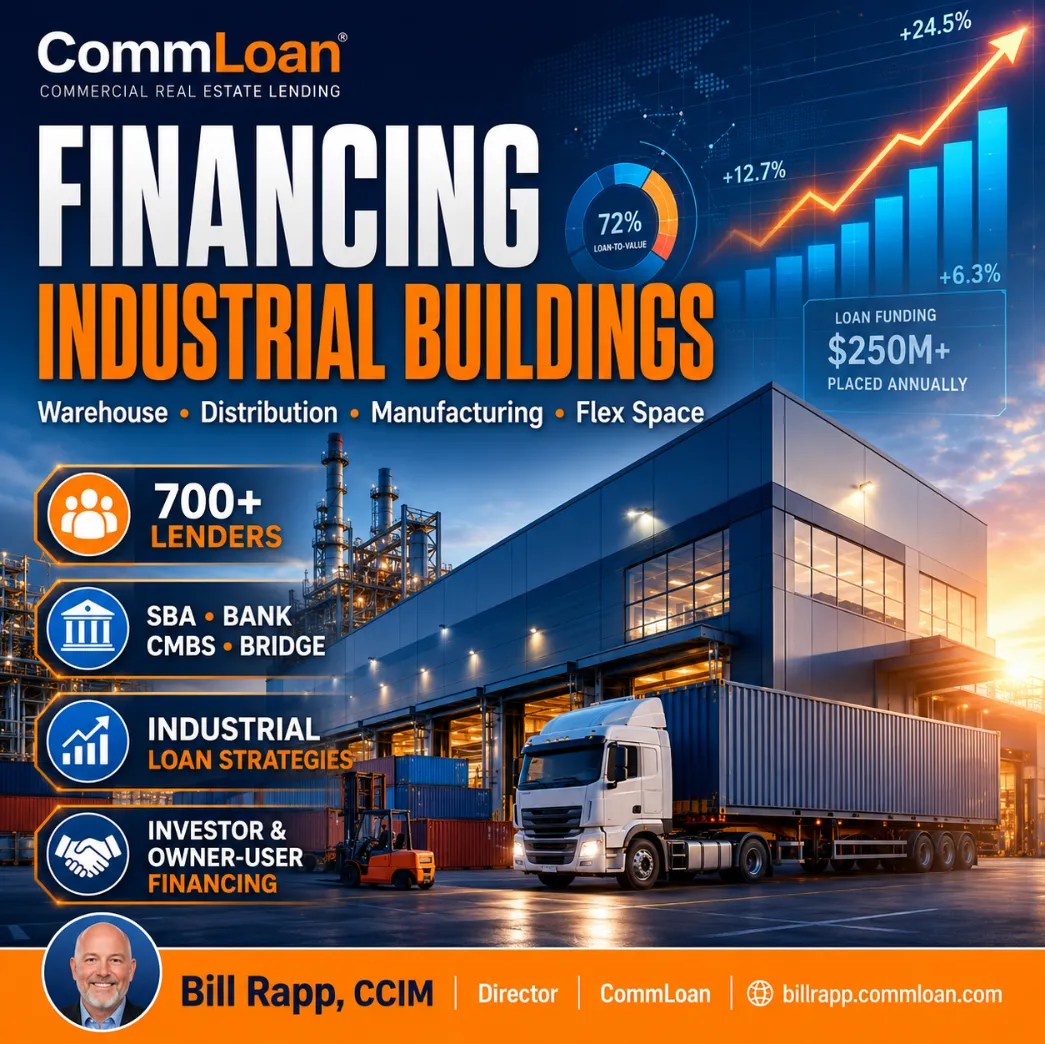
🏭 Financing Industrial Buildings in Today's Market: What Investors Need to Know 💰
🏭 Financing Industrial Buildings in Today's Market: What Investors Need to Know 💰
🚀 Industrial Real Estate Loans Explained: How to Finance Warehouses, Flex Space & Distribution Centers 📦
Financing Industrial Buildings in Today's Market
Industrial real estate has become one of the strongest-performing commercial property sectors in the United States. Fueled by e-commerce growth, supply chain reshoring, manufacturing expansion, and increasing demand for logistics facilities, industrial properties continue attracting both investors and owner-users.
However, securing financing for industrial buildings in today's market requires understanding lender expectations, property fundamentals, and available loan options.
Whether you're purchasing a warehouse, distribution center, manufacturing facility, flex space property, or industrial investment asset, understanding how lenders evaluate industrial deals can help you secure better financing terms and maximize returns.
Why Industrial Real Estate Remains Attractive
Industrial assets have demonstrated strong resilience through multiple market cycles because they support essential business functions:
·Warehousing
·Manufacturing
·Logistics
·Distribution
·Last-mile delivery
·E-commerce fulfillment
·Contractor storage
·Service businesses
Unlike some commercial sectors facing uncertainty, industrial demand remains supported by long-term economic trends.
Key drivers include:
✔ Growth of online retail
✔ Supply chain diversification
✔ Domestic manufacturing expansion
✔ Population growth in Sunbelt markets
✔ Increased demand for distribution infrastructure
As a result, many lenders continue to view industrial properties favorably.
What Lenders Look For in Industrial Properties
Every lender evaluates risk differently, but most focus on several key factors:
1. Property Type
Industrial buildings vary significantly:
·Warehouse
·Distribution Center
·Flex Industrial
·Manufacturing Facility
·Cold Storage
·R&D Space
·Industrial Outdoor Storage (IOS)
Certain property types receive stronger lender interest due to broader market demand and easier resale potential.
2. Occupancy and Cash Flow
For investment properties, lenders primarily focus on:
·Current occupancy
·Rent roll quality
·Tenant creditworthiness
·Lease term remaining
·Net Operating Income (NOI)
Properties with strong tenants and stable cash flow typically receive more competitive financing.
3. Debt Service Coverage Ratio (DSCR)
Industrial lenders commonly require:
·DSCR of 1.20x to 1.35x
Higher DSCR generally results in:
·Better pricing
·Lower risk premiums
·Increased leverage opportunities
4. Loan-to-Value (LTV)
Typical leverage ranges include:
Property Type
Typical LTV
Stabilized Industrial
70% - 80%
Single-Tenant Industrial
65% - 75%
Manufacturing Facilities
60% - 75%
Value-Add Industrial
60% - 70%
Bridge Loans
60% - 75%
The stronger the property and sponsorship, the higher the leverage potential.
Common Financing Options for Industrial Buildings
Conventional Bank Financing
Traditional banks remain one of the most common financing sources.
Best For:
·Owner-users
·Local investors
·Stabilized properties
Typical Features:
·5, 7, or 10-year fixed periods
·20-25 year amortizations
·Competitive interest rates
·Recourse guarantees
Credit Union Financing
Credit unions often provide:
·Flexible underwriting
·Competitive pricing
·Relationship-based lending
These lenders can be excellent options for owner-occupied industrial buildings.
SBA Financing
For owner-users occupying at least 51% of the building:
SBA 504
Ideal for:
·Warehouses
·Manufacturing facilities
·Industrial owner-users
Benefits:
·Up to 90% financing
·Long-term fixed rates
·Lower down payments
CMBS Financing
Commercial Mortgage-Backed Securities (CMBS) financing works well for:
·Larger industrial assets
·Stabilized properties
·Investors seeking non-recourse debt
Advantages:
·Higher leverage
·Long-term fixed rates
·Non-recourse structures
Life Company Financing
Life insurance lenders often provide some of the most attractive terms available.
Best For:
·Institutional-quality industrial assets
·Strong sponsorship
·Long-term holds
Benefits:
·Low rates
·Long amortizations
·Flexible structures
Bridge Loans
Bridge financing can be valuable when:
·Acquiring vacant industrial assets
·Repositioning properties
·Funding improvements
·Leasing-up vacant space
Bridge loans provide speed and flexibility when traditional financing isn't immediately available.
Why Technology Is Changing Industrial Lending
Historically, commercial borrowers had to contact numerous lenders individually to compare options.
Today, technology-driven lending marketplaces are transforming the process.
CommLoan's CUPID™ platform helps match borrowers with lenders based on property type, loan structure, leverage requirements, borrower experience, and investment objectives. Through a network of more than 700 lending sources, borrowers gain access to banks, credit unions, agency lenders, life companies, debt funds, CMBS lenders, and private capital sources.
This technology-driven approach helps investors identify financing options more efficiently while comparing rates, terms, prepayment structures, and lender requirements. The platform supports a wide range of property types, including industrial, multifamily, retail, office, hospitality, self-storage, and special-use assets.
Industrial Financing Strategies for Investors
Stabilized Warehouse
Consider:
·Bank financing
·Credit unions
·Life company loans
·CMBS financing
Value-Add Industrial
Consider:
·Bridge loans
·Debt funds
·Private capital
Owner-Occupied Facility
Consider:
·SBA 504
·SBA 7(a)
·Conventional bank financing
Large Portfolio Acquisition
Consider:
·CMBS
·Life Company
·Institutional debt funds
Final Thoughts
Industrial real estate continues to be one of the most attractive sectors in commercial real estate. Strong tenant demand, expanding logistics infrastructure, and continued economic growth create significant opportunities for investors and owner-users alike.
The key is securing the right financing structure for your specific property, business plan, and long-term objectives.
With access to over 700 lenders and thousands of loan programs through CommLoan's technology platform, borrowers can efficiently compare financing options across banks, credit unions, life companies, CMBS lenders, debt funds, and private capital providers.
If you're considering purchasing, refinancing, or developing an industrial property, understanding today's lending landscape can make the difference between a good deal and a great one.
Bill Rapp, CCIM
Director | CommLoan
📞 281-222-0433
📧 [email protected]
🌐 https://billrapp.commloan.com/
Commercial Real Estate Financing Nationwide
https://billrapp.commloan.com/
https://author.billrapponline.com/
https://www.amazon.com/dp/B0F32Z5BH2
https://veed.cello.so/FOmzTty6oi9
https://buymeacoffee.com/vikingente3
https://creplaybookseries.billrapponline.com
https://creplaybook.billrapponline.com/
©Bill Rapp, CCIM - Director - Commloan